|
Additions to the elasmobranch fauna from the upper Cretaceous of New Jersey (middle Maastrichtian, Navesink Formation)
Published online: 15/12/2004
Keywords:
Elasmobranchs; New Jersey; new species; Upper Cretaceous; USA
https://doi.org/10.18563/pv.33.1-4.1-16
Abstract
A recently discovered, almost complete specimen of a hybodont tooth, allows us to describe as a new species, fairly common, but usually fragmentary teeth in the Navesink Formation of New Jersey: Hybodus novojerseyensis nov. sp.
Three additional taxa are also described : Heterodontus creamridgensis, Squalicorax sp. and Pseudocorax affinis which is noted for the first time in North America.
The whole elasmobranch fauna of the Early Maastrichtian localities of New Jersey is reevaluated and several generic assignments are changed in comparison to the list previously published in 1975 (Cappetta
& Case).
PV article infos
Published in Vol. 33, Fasc. 1-4 (2004)
|
PDF
|

|
Carolocoutoia ferigoloi nov. and sp. (Protodidelphidae), a new Paleocene "opossum-like" marsupial from Brazil.
Published online: 15/12/1998
Keywords:
Brazil; Didelphimorphia; Itaborai; Marsupialia; New taxa; Paleocene; Protodidelphidae; South America
https://doi.org/10.18563/pv.27.3-4.145-154
Abstract
Carolocoutoia ferigoloi gen. et sp. nov. is the largest of protodidelphid marsupials, known from Middle Paleocene levels at Itaboraí Formation, southeastern Brazil. It differs from other members of this family in having molars with low cusps which are basally inflated, rounded crests without cutting edges, and a thick enamel layer which is wrinkled, specially at the labial half. A comparative analysis among representatives of this family led us to recognize only three genera undoubtely assignable to it: Protodidelphis PAULA COUTO, 1952, Robertbutleria MARSHALL, 1987, and Carolocoutoia gen. nov. Protodidelphids lack the basic derived features diagnostic of Polydolopimorphian marsupials, while most of its derived features agree with its belonging to the Didelphimorphia. Protodidelphids comprise a specialized clade of opossum-like marsupials adapted to frugivorous or frugivore-omnivorous feeding habits. They differ from other didelphimorphians in having very large, spire-like entoconids, reduced and antero-posteriorly compressed paraconids, absence of stylar cusp C and of para- and metaconules, large stylar cusps B and D which are proximate to each other, short postmetacristae, eccentric protocones, and molars that increase rapidly in size from M/ml to M/m3.
PV article infos
Published in Vol. 27, Fasc. 3-4 (1998)
|
PDF
|

|
Neolicaphrium recens Frenguelli,1921,the only surviving proterotheriidae (Litopterna, Mammalia) into the south american Pleistocene.
Published online: 30/07/2001
Keywords:
Litopterna; Neolicaphrium recens; Pleistocene; Proterotheriidae; South America
https://doi.org/10.18563/pv.30.1-2.37-50
Abstract
The litoptem Proterotheriidae are extinct endemic South American ungulates frequently used as an example of evolutionary convergence with the horses. They were considered to be exclusively Tertiary representatives with the youngest record being in the late Pliocene, before the appearence of the equids and cervids during the Great American Interchange. Two undoubted Pleistocene records in Argentina and the specimen here described from Uruguay, confirm the persistence of the proterotherids into that period. In the Quaternary, these ungulates are found outside the typical pampean region and probably were confined to a few northern and warmer more forested relictual microhabitats.
PV article infos
Published in Vol. 30, Fasc. 1-2 (2001)
|
PDF
|
|
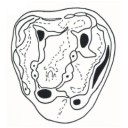
The beginning of the adaptive radiation of Theridomorpha (Rodentia) in Western Europe: morphological and phylogenetic analyses of early and middle Eocene taxa; implications for systematics
Published online: 20/09/2021
Keywords:
characters analyses; Dental morphology; Eocene; Rodentia; variability
https://doi.org/10.18563/pv.44.2.e2
Abstract
This paper provides a revision of the early and middle Eocene European rodents previously referred to as Ischyromyoidea, including taxa considered to be at the origin of the Theridomorpha. The use of an accurate dental terminology and a better understanding of the size and shape of their infra-orbital foramen (i.o.f.) led us to a substantial revision of this group, which allowed to better characterize them and to appreciate their variability. On these bases, phylogenetic analyses (cladistic and standard Bayesian
approaches) of early Ypresian to late Priabonian European rodent species were undertaken in order to highlight the root of the early Theridomorpha and its content. In this paper, the phylogeny was established based on 343 characters (338 dental) through 45 early Paleogene taxa using both cladistic and bayesian analyses. The ingroup included on one hand a few North American genera (Reithroparamys, Microparamys, and Acritoparamys) and European ones (Eogliravus, Ailuravus, Corbarimys, Meldimys, Euromys, Plesiarctomys, and Pseudoparamys) considered until now as being related with the North American superfamily Ischyromyoidea. On the other hand, it included genera close to the root of the Theridomorpha (Sparnacomys, Pantrogna, and Hartenbergeromys) and early Theridomyoidea (Masillamys, Protadelomys, and some Pseudosciuridae). The phylogenetic results obtained via the two
distinct reconstruction approaches are consistent in virtually all relationships. The proposed systematics here derives from these phylogenetic results. This phylogenetic context led us to change the suprafamilial, familial, subfamilial or generic attribution of several species. Characters of Theridomorpha, like the obliquely developed postprotocristid allied with the occurrence of a metalophulid I, have been found in genera previously considered as Ischyromyidae (Pseudoparamys, Euromys, Sparnacomys, Meldimys, Pantrogna, and Hartenbergeromys) as well as the large i.o.f., when preserved (Pseudoparamys, Hartenbergeromys, and Masillamys). Based on these morphological observations and new phylogenetic considerations, the content of the Theridomorpha clade is here enlarged, thereby extending back the first theridomorph radiations to the early Eocene. Aside, a new taxon (Reinomys rhomboides gen and sp. nov.) is described from Avenay. In addition, a new genus, Auroremys, is created for the species subita (Comte et al., 2012) from Chery-Chartreuve.
PV article infos
Published in 44-2 (2021)
|
PDF
S.I. Data
|

|
Sur le remplissage des "poches à phosphorite" d'Aubrelong (commune de Bach, Lot)
Published online: 15/11/1974
Keywords:
Aubrelong; Quercy Phosphorites
https://doi.org/10.18563/pv.6.1-2.21-25
Abstract
L’article analyse les poches à phosphorite d’Aubrelong (Quercy), comparant les fouilles de 1937 (Éocène supérieur) et celles des années 1967-1970 (Oligocène inférieur), révélant une stratification contrastée : argiles brunes pauvres en fossiles en surface, et argiles rouges riches en phosphates et faune en profondeur. Les analyses géochimiques confirment une origine latéritique sous climat tropical humide, avec des remplissages tantôt stratifiés, tantôt chaotiques, remettant en cause l’hypothèse d’une progression chronologique uniforme des dépôts
PV article infos
Published in Vol. 06, Fasc. 1-2 (1974)
|
PDF
|

|
Analyse d'ouvrage: “A.G. SMITH, D.G. SMITH & B.M. FUNNELL: Atlas of Mesozoic and Cenozoic coastlines (1995)”
Published online: 18/03/1996
Keywords:
Atlas; Book review; Cenozoic; Coastlines; Mesozoic
https://doi.org/10.18563/pv.25.1.56
Abstract
ATLAS OF MESOZOIC AND CENOZOIC COASTLINES, par Alan G. SMITH, David G. SMITH & Brian M. FUNNELL, 1995. Cambridge University Press, 99 p., 31 cartes, 3 tab!., 2 fig. ISBN 0-521-45155-8.
L' "Atlas of Mesozoic and Cenozoic coastlines" succède avec bonheur aux "Mesozoic and Cenozoic paleocontinental maps" de Smith & Briden, publié en 1977.
PV article infos
Published in Vol. 25, Fasc. 1 (1996)
|
PDF
|

|
First record of dinosaur eggshells and teeth from the north-west african Maastrichtian (Morocco).
Published online: 15/12/2003
Keywords:
Africa; amniotic eggshells; Maastrichtian; Morocco; theropod teeth
https://doi.org/10.18563/pv.32.2-4.59-69
Abstract
We report the discovery of amniotic eggshells and theropod teeth from the Late Cretaccous period in Morocco.The megaloolithid family represents the only known dinosaur egg remains in the north part of Africa and attests indirectly to the occurrence of sauropod dinosaurs (titanosaurids) in the Maastrichtian of Africa.
PV article infos
Published in Vol. 32, Fasc. 2-4 (2003)
|
PDF
|

|
Stratigraphy and Oligocene-Miocene mammalian biochronology of the Aktau Moutains, Dzhungarian Alatau Range, Kazakhstan
Published online: 16/12/1996
Keywords:
Dzhungarian Alatau; Kazakhstan; Lithologic correlation; Mammalian biochronology; Miocene; Oligocene; Stratigraphy
https://doi.org/10.18563/pv.25.2-4.141-174
Abstract
Stratigraphic studies in the Aktau Mountains bordering the Dzhungarian Alatau Range in southeastern Kazakhstan have included mapping of Tertiary lithostratigraphic units, documentation of fossiliferous deposits, correlation of sections, etc. These investigations have led in turn to revised interpretation of the Tertiary geology of the area. The Tertiary sequence in the Aktau Mountains is represented by three lithostratigraphic units (in ascending order): (1) the middle Eocene Akbulak Formation; (2) the Oligocene Aktau Formation with a lower member including white quartz sands that contain fossil mammals, and an upper member including red-colored clays and sandstones, brick red clays, an anhydrite and gypsum clayey horizon, and bright brown-red clays; and (3) the upper Oligocene-Miocene Chul'adyr Formation with a lower member of greenish and yellowish conglomerates and gritstones, a middle member including grayish and yellowish sands and gritstones, and an upper member including brown and red clays and carbonate- and anhydrite-rich clays. The Aktau and Chul”adyr Formations represent separate cycles of sedimentation. Mammalian biostratigraphy and biochronology of the three vertebrate faunas in Aktau Mountains are reviewed. The mammalian fauna from white sands of the lower Aktau Formation is small but includes Ardynia and is thought to be early Oligocene in age. The mammalian fauna from conglomerates and gritstones of the lower member of the Chul”adyr Formation is also small but includes Paraceratherium and is thought to be late Oligocene in age. The mammalian fauna from sands of the middle member of the Chul'adyr Formation is extensive, with micro- and macrofauna attributed to Neogene mammal zones MN4 to MN 6, indicating a latest early Miocene to earliest middle Miocene age (Orleanian-Astaracian). Most genera of middle Chul”adyr mammals are known from the middle Miocene Shanwang faunas of China and from the Castelnau-d”Arbieu faunal assemblage (MN4-MN6) of southwestern France.
PV article infos
Published in Vol. 25, Fasc. 2-4 (1996)
|
PDF
|

|
Cricetid and arvicolid rodents of the California wash local fauna, late Blancan of the san Pedro Valley, Arizona.
Published online: 15/12/1997
Keywords:
Arvicolidae; Blancan; Cenozoic; Cricetidae; Mammals
https://doi.org/10.18563/pv.26.1-4.189-218
Abstract
An assemblage of micromammals is reported from California Wash, a fossil bearing continental deposit in the San Pedro Valley, Arizona, late Blancan in age. Cricetid and Arvicolid rodents are richly represented, including four and two species, respectively. This study mainly focuses on Sígmodon, the most abundant form. The sample of Sigmodon is compared to samples of the same genus from other localities of the San Pedro Valley of comparable age, and some inferences on the taxonomy of the genus are attempted. The specimens are referred to Sigmodon minor and Sigmodon cf. S. curtisi. Other cricetids (Onychomys pedroensis and Baiomys brachygnathus) and arvicolids (Mictomys vetus and Ondatra ídahoensis) are also recognized and described.
PV article infos
Published in Vol. 26, Fasc. 1-4 (1997)
|
PDF
|

|
Contribution à l'étude des Cricétidés oligocènes d'Europe occidentale
Published online: 20/01/1972
Keywords:
Cricetidae; Europe; Oligocene
https://doi.org/10.18563/pv.5.1.1-44
Abstract
Of the ten cricetid species from the Oligocene of Western Europe, attributed until now to the genus Eucricetodon, only four prove to be utilizable - E. atavus, E. huberi, E. praecursor, E. collatum - to which it is possible to add two forms newly described: E. huerzeleri and E. quercyi. The evolullon of the genus Pseudocricetodon is also the subject of new observations. The study of the dental morphology allows us to distinguish in these two genera three lineages beginning in the middle Oligocene:
- Lineage P. montalbenensis-P. thaleri (from Montalban to Goderet), of small size, without
increase in size.
- LineageE. atavus-E. infralactorensis (from Hoogbulsel to Estrepouy), of middle size, with a regular increase in size.
- Lineage E. huerzeleri-E. haslachense (level of Montalban to that of Estrepouy), of large size, with an increase in size.
Two other forms are equally represented in these loealitles: Heterocricetodon aff. helbengi and Melissiodon quercyi. It has been possible to attribute a precise age (zone of "Cournon") to the last species, which has been defined by Schaub (l925) from material in the Old Quercy collections. The genera Pseudocricetodon, Eucricetodon, ? "Cricetodon", Leydimys, Eumys, differentiated at the beginning of the middle Oligocene in Europe, Asia and North America, seem to derive from a common ancestral group. The place of origin of this group could be situated in Asia.
PV article infos
Published in Vol. 05, Fasc. 1 (1972)
|
PDF
|

|
Leptacodon nascimentoi n,sp., un nouveau Nyctitheriidae (Mammalia,Lipotyphla) de l'Eocène inférieur de Silveirinha (Baixo Mondego, Portugal)
Published online: 16/12/1996
Keywords:
Eocene; Leptacodon; Lipotyphla; Mammals; Nyctitheriidae; Portugal; Silveirinha
https://doi.org/10.18563/pv.25.2-4.275-286
Abstract
In this article is described a new species of Nyctitheriidae with primitive characters: Leptacodon nascimentoi n. sp. from the early Eocene of Silveirinha (Portugal).
PV article infos
Published in Vol. 25, Fasc. 2-4 (1996)
|
PDF
|

|
Experimental taphonomy inavian eggs and eggshells: effects on early diagenesis.
Published online: 15/12/2003
Keywords:
archosaurian eggshells; avian egg; Experimental taphonomy; geochemical analysis; pyritisation; Upper Cretaceous
https://doi.org/10.18563/pv.32.2-4.77-95
Abstract
We experimentally explore the early taphonomic stages involving the decay and biodegradation of buried eggs and eggshells. Unfertilised commercial chicken eggs and eggshell fragments were buried in plastic containers and were kept under controlled conditions for eight months. Half of the containers were filled with marl, and the remainder with sand. All were saturated with fresh tap water, acidified water, sulphate water, or seawater. They were kept in the dark at 23.4-26 °C, except one, which was kept in a heating chamber at 37.4°C. We expected that different burial conditions would produce distinct taphonomic outcomes. Instead, the taphonomic alterations of buried eggs parallel that of the alteration of egg proteins (i.e., denaturation and/or putrefaction) with an additional role played by the eggshell. Mummification, encrustation, distortion and fragmentation, and necrokynesis (vertical displacement) depend on organic matter decay. The experiment identifies environmental conditions that may favour or actively promote these taphonomic processes. Of these, early pyritization is one of the most relevant. For comparative purposes, samples of fossil and extinct eggshell representing three distinct environmental burial conditions were examined. These included Megaloolithus, Caiman crocodilus, and Struthio camelus ootypes. The geochemical analysis of these eggshells showed no significant differences among the chemical variables of these fossil and extant ootypes. Eggshells exhibited a stable composition over a range of experimental conditions.
PV article infos
Published in Vol. 32, Fasc. 2-4 (2003)
|
PDF
|

|
Evolution of the Rhizomyine zygoma
Published online: 30/12/1985
Keywords:
parallel evolution; Rhizomyidae; Rodentia; Siwalik; zygoma
https://doi.org/10.18563/pv.15.3.129-138
Abstract
Cranial anatomy of a late Miocene rhizomyid, Brafhyrhizomys cf. B. pilgrimi, provides new evidence on the origin of the dorsal, round infraorbital foramen of living rhizomyines. Primitive rhizomyids retain a myomorphous keyhole foramen with a long ventral slit that retracts upward during the evolutionary history of the Rhizomyidae. The primitive condition of the elongated ventral slit is represented by Kanisamys sivalensis. Among later burrowers the foramen shows progressive dorsal migration, the ventral slit terminating midway up the snout in B.tertracharax and B. choristos ; well above the midline of the snout in Brachyrhizamys cf. B. pilgrimi. Apparently this transformation began earlier among Rhizomyinae than among Tachyoryctinae and continued to a more derived stage in rhizomyines. ln living Rhizomyx the ventral slit is absent and only a high round hole remains at the anterior end of the zygomatic arch.
PV article infos
Published in Vol. 15, Fasc. 3 (1985)
|
PDF
|

|
Les rongeurs de l'Eocène d'Afrique Nord-Occidentale [Glib Zegdou ( Algérie) et Chambi (Tunisie)] et l'origine des anomaluridae.
Published online: 20/05/1994
Keywords:
Africa; Eocene; New taxa; Paleobiogeography; PHYLOGENY; Rodents
https://doi.org/10.18563/pv.23.1-4.93-118
Abstract
This paper is about the oldest African rodents faunas, from the late Early Eocene, or early Middle Eocene, Glib Zegdou (Algeria) and Chambi (Tunisia) localities. Five species are described and figured, belonging to a new family here created, the Zegdoumyidae.
This family is compared to the Early and Middle Eocene rodents families from Asia, Europe and North America (Chapattimyidae, Yuomyidae, Gliridae, Theridomyidae, lschyromyidae and Sciuravidae), as well as to those known from the Late Eocene African locality Bir El Ater (Anomaluridae and Phiomyidae).
On the one hand, it seems clear that the African endemic Anomaluridae arise from the Zegdoumyidae. On the other hand, the lschyromyidae, or primitive Sciuravidae, may be the most reliable ancestral groups for the Zegdoumyidae. Thus, this new family can be considered as the sister group for the American Sciuravidae on the one hand, and for the European Gliridae on the other hand.
The biogeographical consequences of these phylogenetic hypotheses are discussed. A new phase of communication between Europe and North Africa is inferred, during the Early Eocene. It has been followed by a short period of endemism, allowing the adaptive radiation for the Zegdoumyidae, preceding the immigration of the Phiomyidae, during the Late Eocene, probably from Asian relatives.
PV article infos
Published in Vol. 23, Fasc. 1-4 (1994)
|
PDF
|

|
Le genre Plagiolophus (Palaeotheriidae, Perissodactyla, Mammalia): révision systématique, morphologie et histologie dentaires, anatomie crânienne, essai d'interprétation fonctionnelle
Published online: 15/12/2004
Keywords:
New taxa; Paléogène; perissodactyls; skull anatomy; tooth histology
https://doi.org/10.18563/pv.33.1-4.17-281
Abstract
The genus Plagiolophus is documented, almost solely in Western Europe, from the middle Eocene up to the mid Oligocene (MP 12 to MP 25), i.e. more than for 15 MY. Seventeen species are now recorded whose two of them are new, P. ringeadei nov. sp. and P. mamertensis nov. sp. Some anatomical variations and the deflection of certain evolutionary trends justify the distinction of three subgenera, Paloplotherium, Fraasiolophus nov. and Plagiolophus s.s. The genus displays a wide range in size and weight (between 10 and 150 kg). The detailed description of the skull of several species is here given for the first time.
Despite important evolutionary drifts during this long time span, the dentition shows a great structural homogeneity, which renders difficult the determination of fragmentary specimens or isolated teeth. It is characterized by a great heterodonty; premolars are little molarized and present a certain regression through time with paradoxically some progress in the molarization. The hypsodonty increases: the first Plagiolophus are hardly less brachyodont than Propalaeotherium, and the last ones are nearly as hypsodont as Merychippus from the early Miocene. The upper molars change from a wide crown pattern, with an open occlusal surface, lightly oblique transverse lophs and rounded internal cusps, to a narrower pattern, with a frontally constricted occlusal surface and internal lophs aligned parallel to the ectoloph. The M3/3 become always longer.
The dental enamel displays horizontal Schreger-bands with imprecise limits occupying only the middle part of the enamel layer. The dentine is remarkable by its high rate of pericanalicular dentine. The crown cementum, lacking in earlier forms, increases to the point where it fills the occlusal valleys of the
teeth.
The masticatory musculature shows a increasing prominence of the temporal, with probably an important role devoted to the pterygoid muscles in lateral movements related to a two-phase type of chewing.
The evolution of the dentition, of the masticatory musculature and of the repartition of masticatory forces indicate that the Plagiolophus have known different diets through their long evolutionary history; at first browsers they became mixed feeders and finally grazers. Their relatively long neck allowed these animals to reach different vegetal layers. The strength of the nuchal crests also suggests that they were able to have strong backwards movements of the head to pull up their food.
This evolution of diet seems related to the slow degradation of environmental conditions attested during this period in western Europe, with the generalization of more open landscapes, increasing aridity and more marked seasons.
Besides, a remodeling of the face is ontogenetically and along time observed, in relation with the evolution of the masticatory apparatus and especially with that of the mandibular lever arm. The postcanine diastemata become longer in the course of evolution; the free extremities of the nasals are always relatively long which contradicts the hypothesis according to which Paloplotherium may have had a trunk. At last the lineage Fraasiolophus can be distinguished by the presence of a deep malar fossa, probably related to a strong development of the maxillo-labialis superior muscle.
The orbit is always large and tends to increase in size, which indicates a good development of the vision and its increasing role in the life relations. A peculiar type of epitympanic sinus could have been used as a resonance chamber insuring a certain amplification of sounds before their transmission to the eardrum. The endocranial cast reveals a relatively large brain with an advanced degree of gyrencephaly. Beside the role eventually played in food research and social relations, these neurophysiological abilities, also related to an advance in cursorial fitness, could have contributed to the survival of these animals facing the predation pressure of the first fissipede carnivores and the competition with new immigrant herbivores after the "Grande Coupure".
On the basis of some shared apomorphies with the Pachynolophinae, which prevent from considering the latter as Equidae (molarization of the premolars, reduction of the premaxilla dorsal apophysis, peculiar epitympanic sinus, splitting of the jugular process), the hypothesis of an autochthonous origin of Plagiolophus issued from a form near Propalaeotherium, is once again proposed and discussed. Finally, intra-generic relationships are taken into consideration.
PV article infos
Published in Vol. 33, Fasc. 1-4 (2004)
|
PDF
|

|
Analyse d'ouvrage : A.J.Sutcliffe. On the track of Ice Age mammals
Published online: 30/12/1985
Keywords:
Book review
https://doi.org/10.18563/pv.15.4.270
Abstract
On the Track of Ice Age Mammals justifie pleinement son titre car l'auteur, Anthony J. Sutcliffe, apporte au lecteur faits et interprétations qui l'amèneront à s'intéresser encore plus au passé récent et à l'avenir de son environnement et à la question de l'impact de l'homme sur la nature. Après les chapitres qui présentent les temps glaciaires et les divers témoignages qui nous en sont parvenus, les cinquième et sixième apportent les informations nécessaires à la compréhension des résultats que nous donnent les chercheurs: principes, moyens d'étude et limites des méthodes, difficultés de l'intégration des données dans un cadre stratigraphique, variabilité des signaux climatiques, variabilité de leur intensité selon l'endroit par rapport au centre de la glaciation, complications liées à la qualité inégale de l'enregistrement géologique, en mer et sur le continent.
PV article infos
Published in Vol. 15, Fasc. 4 (1985)
|
PDF
|

|
Les sélaciens du Miocène de la région de Montpellier
Published online: 15/12/1970
Keywords:
Ichtyofauna; Miocene; Montpellier
https://doi.org/10.18563/pv.3.ext.1-139
Abstract
The utilization of screen-washing and attack by dilute acetic acid has permitted the collecting, in the Miocene of the department of Hérault (France), of a very rich ichthyofauna. This fauna is presently comprised of about 60 studied species, of which 11 are new, and represents, in the present state of knowledge, the most varied Miocene selachian fauna described in the world.
The abondance of material has allowed an overall revision to be made; it has thus been possible to complete the description and the figuration of species that were poorly known until now, and to synonymize species that were established on simple morphotypes. Paleo-ecologic study of the ichthyofauna has permitted conclusions to be drawn relative to climate and bathymetry; it was thus possible to show that the Miocene fauna of Hérault was a fauna of a subtropical sea, essentially neritic with rare pelagic contributions.
Knowing the stratigraphic position of the localities, it has been possible to distinguish three faunal assemblages based on associations of species. Some hypotheses on the evolution of certain lineages have been expressed.
The comparison of this fauna with that of other regions permitted the relationships of two diflerent faunal provinces to be specified: the first belongs to the northern domain, characterized by a fauna still subtropical but with numerous temperate water elements; the leoond belongs to the Mesogean domain characterized by warm water forms. It has also lhovm that contemporary faunas could be very different according to the bathymetric zone in which they lived, which furnishes valuable information for the paleogeographic reconstruction of sedimentary basins.
PV article infos
Published in Vol. 3, Ext (1970)
|
PDF
|
|
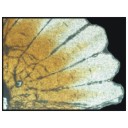
First report of Cylindracanthus (Osteichthyes) from the Eocene of India
Published online: 25/03/2024
Keywords:
Cylindracanthus; Eocene; histology; rostrum; Umarsar mine.
https://doi.org/10.18563/pv.47.1.e2
Abstract
Fossils of the endangered sturgeons and peddlefishes are widely distributed. We here report for the first time the presence of one of the extinct osteichthyes genus Cylindracanthus (Liedy 1856a) from the Early Eocene lignite-bearing successions of the Kutch Basin, India. The present well preserved rostrum is characterised by numerous wedge-shaped components encircling the central canal that runs along its length, paired at the base and each wedge contributing to the formation of a ridge. The rostrum lacks teeth. The present find extends the palaeobiogeographical distribution of Cylindracanthus considerably and supports its Eocene age as dental remnants preserved in Cylindracanthus sp. shows a decrease in remanent dentition and tooth bases from the Cretaceous to the Eocene. Cylindracanthus is an useful palaeoenvironmental indicator as it has been found associated typically with deposits of nearshore marine environments.
PV article infos
Published in 47-1 (2024)
|
PDF
|
|
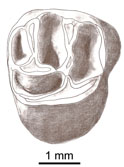
Rodent paleocommunities from the Oligocene of Ulantatal (Inner Mongolia, China)
Published online: 10/06/2014
Keywords:
late Paleogene; Mammalia; Mongolian Plateau; Rodentia; Systematics
https://doi.org/10.18563/pv.38.1.e3
Abstract
The Oligocene deposits of the Ulantatal area in Inner Mongolia (China) contain among the richest mammalian faunas from Asia. To date, only some parts of the rodent faunas have been described. Here, we propose to review the rodent faunal lists for each site, including the description of a few new rodent specimens. We describe three additional rodent species: the Cylindrodontidae Anomoemys lohiculus, the Eomyidae Asianeomys sp., and the Dipodidae Litodonomys huangheensis. This study allows us to constrain the stratigraphic range of Anomoemys lohiculus, which ranged from the late Early Oligocene to the early Late Oligocene in this area. Asianeomys sp. and Litodonomys huangheensis are dated from the latest Oligocene. These Oligocene deposits consist now of more than 70 species of mammals if we include the fauna from Kekeamu. This latter corresponds to the basal part of the Ulantatal Formation and could be dated biochronologically from the earliest Oligocene. When compared to the faunas from the Valley of Lakes in Central Mongolia, the Ulantatal faunas present a great majority of rodents, and this difference can be partly explained by sampling and description biases regarding macro-mammals. This study also shows that variations existed between Inner and Central Mongolia, especially regarding the composition of the rodent paleocommunities. However, the assessment of their evolutionary history in this part of Asia with respect to the important climate and environment changes, require further precisions and more material than current data allow.
PV article infos
Published in Vol.38-1 (2014)
|
PDF
|

|
Rana (Amphibia : Ranidae) from the upper eocene (MP17a) Hordle Cliff locality, Hampshire, England.
Published online: 15/06/1999
Keywords:
Amphibia; England; Rana; Ranidae; Upper Eocene
https://doi.org/10.18563/pv.28.1.47-51
Abstract
An ilium from the Upper Eocene (MP l7a) of Hordle, England, represents the first report of Rana from the Eocene of Britain. The ilium is similar to those of the water frog (Rana [ridibunda]) species group.
PV article infos
Published in Vol. 28, Fasc. 1 (1999)
|
PDF
|