
Abstract book of the 18th Conference of the EAVP
Pterosaurs from Coahuila
New elephant cranium from early Pliocene Ileret, Kenya
Les sélaciens du Miocène de la région de Montpellier
Muridae du Pliocène supérieur d'Espagne et du midi de la France.
Contribution à l'étude des genres Gliravus et Microparamys.
Eocene (57) , Quercy Phosphorites (38) , Systematics (32) , Rodents (29) , Mammalia (27) , Rodentia (25) , Miocene (25)
Page 18 of 19, showing 20 record(s) out of 366 total

|
La poche à phosphate de Ste-Néboule (Lot) et sa faune de vertebres du Ludien supérieur. 7- Didelphides (Marsupiaux)Jean-Yves CrochetPublished online: 25/09/1978Keywords: Eocene; Quercy Phosphorites https://doi.org/10.18563/pv.8.2-4.231-242 Abstract The family Didelphidae is represented by three species in the Sainte-Néboule site, phosphorites of Quercy (lower Oligocene, San Cugat's nivel): Amphiperatherium minutum (Aymard), Amphiperatherium sp. and Peratherium cuvieri (Fischer). Only the first and third species are abundant (88 and 97 pieces). This two populations are described. The marsupial fauna of the european lower Oligocene is not recognized in its entirety in this site. PV article infos Published in Vol. 08, Fasc. 2-4 (1978) |
|

|
Avant propos au "Premier catalogue des specimens-types Paléontologiques déposés dans les collections de l'Université de Montpellier II"Jean-Jacques Jaeger
Published online: 20/12/1994 |
|

|
Les Tayassuidés des phosphorites du QuercyLéonard GinsburgPublished online: 15/11/1974Keywords: Quercy Phosphorites; Tayassuidae https://doi.org/10.18563/pv.6.1-2.55-85 Abstract Revision of the Tayassuidae from the old collections of the Quercy leads to interesting facts about taxonomic and phylogenetic problems. It could not have been well done without constant comparison with contemporaneous Tayassuidae from stratified series, as well as with European Miocene Tayassuidae and Hyotheriinae. The result is that only three species are present in the Phosphorites of Quercy: Doliochoerus quercyi FiLHOL (represented by two sub-species: the older, D. quercyi quercyi and the more recent, D. quercyi aquensis), Palaeochoerus gergorianus CROIZET et BLAINVILLE and Palaeochoerus purillus nov. sp. The two former species disappeared with Stampian time, while the third is the direct ancestor of the Aquitanian Palaeochoerus typus POMEL, which became extinct before the beginning of Burdigalian. PV article infos Published in Vol. 06, Fasc. 1-2 (1974) |
|

|
Un nouveau type de coquille d'oeuf présumé Dinosaurien dans la Campanien et le Maestrichtien continental de Provence.Philippe KerourioPublished online: 04/10/1982Keywords: Campanian/Maastrichtian; eggshell microstructure; Provence https://doi.org/10.18563/pv.12.4.141-147 Abstract The discovery of eggshells of ornithoid type is signaled for the first time in the continental Campanian and Maastrichtían of Provence. The taxonomie relationship of these eggshells and their interest in the biostratigraphical study of Upper Cretaceous of Provence are discussed. PV article infos Published in Vol. 12, Fasc. 4 (1982) |
|

|
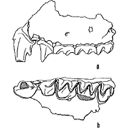
Les Affinités de Nyctereutes megamastoides (Pomel), canidé du gisement Villafranchien de Saint-Vallier (Drôme, France).R. MartinPublished online: 31/01/1971Keywords: Canidae; Nyctereutes; Villafranchian https://doi.org/10.18563/pv.4.2.39-58 Abstract Nyctereutes megamastoides (Pomel) from the Villafranchian of the Auvergne and from Saint-Vallier presents cranial and dental characters sufficiently close to those of the late Pliocene canid from Perpignan (Roussillon), described by Depéret under the specific name of Canis donnezani belonging to the same genus Nyctereutes. The extinction of the European "Nyctereutes" group seems due to the too great alimentary specialization of this canid, whereas the Asiatic lineage represented in the Villafranchian by Nyctereutes sinensis Schlosser and at present by Nyctereutes procyonider Gray was able to maintain itself probably by means of a profound change in its alimentary regime. PV article infos Published in Vol. 04, Fasc. 2 (1971) |
|
|
Les Chiroptères du Miocène inférieur de Bouzigues. 1- Etude systématique.Bernard SigéPublished online: 17/04/1968Keywords: bats https://doi.org/10.18563/pv.1.3.65-133 Abstract In recent years, the techniques of chemical preparing have permitted a rich paleontologic material to be obtained from the phosporitic sediment of Bouzigues (Hérault, France). The fauna of this locality is comprised of quite varied microvertebrates, amphibians, reptiles, birds, mammals. Twenty five species of the latter, belonging to seven orders, are today known from the site. Among them, the numerous rodents have allowed L. Thaler to chronologically situate this fauna in the Zone of Laugnac (<< late Aquitanian ›> of some authors). PV article infos Published in Vol. 01, Fasc. 3 (1968) |
|

|
Octodontid-like Echimyidae (Rodentia) : an upper Miocene episode in the radiation of the familyDiego H. Verzi
Published online: 20/05/1994 |
|

|
Book review : Dr. Robert R. REISZ, 1986. Encyclopedia of Paleoherpetology, Volume: 17A: Pelycosauria.Jean-Yves CrochetPublished online: 20/06/1987Keywords: Book review; Paleoherpetology https://doi.org/10.18563/pv.17.2.75-76 Abstract L’Encyclopedia of Paleoherpetology, Part 17A : Pelycosauria de Robert R. Reisz (1986) offre une synthèse complète des synapsides les plus primitifs et les plus anciens, essentiels pour comprendre l’évolution précoce de ce groupe majeur de vertébrés. L’ouvrage commence par un historique, suivi d’une analyse ostéologique détaillée du crâne, du squelette axial et appendiculaire. PV article infos Published in Vol. 17, Fasc. 2 (1987) |
|

|
Un giraffidae dans le pliocène de Montpellier ?Claude GuérinPublished online: 31/10/1986Keywords: Artiodactyla; France; Giraffidae; Mammalia; Montpellier; Ruscinian https://doi.org/10.18563/pv.16.3.185-189 Abstract An upper giraffid premolar without any indication about its origin is preserved at the Montpellier University among numerous fossils from the ruscinian formation of Montpellier. It can be related to Samotherium, of the Upper Miocene in Eastern Europe, North Africa and Asia, or more probably to Bramatherium or Hydaspitherium of the Pliocene of South East Asia. The sedimentological study of the matrix shows a calcareous background, which may indicate that this tooth does not come from the Montpellier formation. PV article infos Published in Vol. 16, Fasc. 3 (1986) |
|

|
Révision des Artiodactyles de l'Eocène moyen de Lissieu (Rhône)Jean SudrePublished online: 15/05/1972Keywords: Artiodactyles; Dichodon; France https://doi.org/10.18563/pv.5.4.111-156 Abstract The object of this work is the study of the artiodactyls of the karstic locality of Lissieu near Lyon. Among the sixteen species counted, five (Hyperdichobune nobilis, Hyperdichobune sp., Haplabunodon mulleri, Tapirulus depereti and Pseudamphimeryx schlosseri) are cited for the first time in this fauna. The description of part of the anterior dentition of «Dichobune» langi permits the referal of this species to the genus Hyperdichobune. The new selenodont species Dichodon lugdunensis described in this work belongs, with its ancestor Dichodon simplex, to a lineage distinct from that of Dichodan cartieri and Dichodon ruetimeyeri. Finally, the taxonomic reality of the Lissieu species, Lophiobunodon rhodanicum Deperet, is justified. All the other species have been compared with those of Egerkingen. Even though with most of them no difference in age can be shown between the two deposits, some however indicate clearly by their degree of evolution that Lissieu is slightly more recent than Egerkingen. ln the history of Eocene mammals, the Lissieu fauna, because of its homogeneity, can be considered as a sure reference fauna of the Auversian period. PV article infos Published in Vol. 05, Fasc. 4 (1972) |
|

|
La palichnofaune de vertébrés tétrapodes du permien supérieur du Bassin de Lodève (Languedoc-France).Georges Gand, Jacques Garric, Georges Demathieu and Paul EllenbergerPublished online: 15/09/2000Keywords: Footprints; France; Languedoc; Lodève basin; new ichnotypus; Saxonian; Upper Permian https://doi.org/10.18563/pv.29.1.1-82 Abstract Near "la Lieude", in the Lodève basin, more than a thousand of footprints are distributed in a twenty of trackways which amounts to 220 m length. They have been found on calcareous siltstone level in the B site named also "Réserve Naturelle Volontaire". This last is located in the Saxonian summit dated Upper Permian. "La Lieude" tracks are described by using statistical methods then they are compared with others from the world Permian. What allows to distinguish 4 following ichnotaxa: Lunaepes ollierorum nov.ichnosp., Merifontichnus thalerius nov. ichnogen. and nov. ichnosp., Planipes brachydactylus nov.ichnosp. and Brontopus circagiganteus nov. ichnosp. All these traces are attributed with possibility or probability to Therapsida or to Therosauria, except Brontopus circagiganteus nov. ichnosp. that could be due to Caseamorpha. All these animals whose sizes have been estimated between l and 5 m lived probably in a playa environment.The biological and sedimentological data from "la Lieude" footprints levels compared with informations provided by the tracks orientations, suggest the following scenario. Animals coming from the North have crossed a sandy channel bank with plants zones by directing to the South for the majority. Maybe, they were going to the lacustrine part of the playa, close to "la Lieude" footprints that they have just trampled on. PV article infos Published in Vol. 29, Fasc. 1 (2000) |
|

|
Nouveaux Mammifères Eocènes du Sahara OccidentalJean SudrePublished online: 01/11/1979Keywords: Eocene; Mammals; Occidental Sahara https://doi.org/10.18563/pv.9.3.83-115 Abstract The fossil mammals collected from the Eocene of Hammada du Dra (northwest Sahara. Algeria) and two fragmentary teeth from the Lutetian of M'Bodione Dadere (Senegal) are described. PV article infos Published in Vol. 09, Fasc. 3 (1979) |
|

|
Les Pseudosciuridae (Mammalia, Rodentia) de l'Eocène moyen de Bouxwiller, Egerkingen et Lissieu.Jean-Louis HartenbergerPublished online: 30/10/1969Keywords: Bouxwiller; cranium; Egerkingen; Middle Eocene; Rodents https://doi.org/10.18563/pv.3.2.27-64 Abstract The description of new material from three classic middle Eocene localities of western Europe permits the addition of details to the systematics of primitive Pseudosciurids. The cranial anatomy of Protadelomys cartieri (STEHLIN and SCHAUB) from Egerkingen is described here and compared to that of the Adelomyines from the late Eocene, until now the only ones known. The morphologic and biometric study of the dentition of P. cartieri compared to that of P. alsaticus n. sp. from Bouxwiller and P. Iugdunensis n. sp. from Lissieu, forms respectively older and younger than P. cartieri, permits the evolutionary tendencies of the group to be demonstrated and shows that notable differences in age exist between these localities. This ensemble of forms can constitute a valuable guide lineage in the establishment of a fine stratigraphy of the period. Other less well known lineages are present at Egerkingen along with P. cartieri. They can be related to genera that have been noted int he late Eocene. In conclusion, a criticism of recent zonation proposals, made by divers authors, completes this article. PV article infos Published in Vol. 03, Fasc. 2 (1969) |
|

|
New datation of the Tafna Basin (Algeria): A combination between biochronological and magnetostratigraphical dataSalamet Mahboubi
Published online: 11/03/2015 |
|

|
Les Gliridés (Rodentia) de l'Oligocène supérieur de Saint-Victor-la-Coste (Gard).Marguerite HugueneyPublished online: 28/10/1968Keywords: Gliridae; Late Oligocene https://doi.org/10.18563/pv.2.1.1-16 Abstract The locality of St.-Victor-la-Coste (Gard) has yielded, rather abundantly, teeth of two glirids hitherto very poorly known: Glirudinus praemurinus (Freudenberg) and Glirudinus glirulus (DEHM). It has permitted, moreover, new views on the evolution of Peridyromys murinus (POMEL). Study of these forms confirms the late Oligocene age of the fauna, without allowing, however, further precision. PV article infos Published in Vol. 02, Fasc. 1 (1968) |
|

|
This review critiques the third edition (1986) of The Animals (Systematische Zoologie), a descriptive zoology textbook first published in 1976. The book focuses on morphology, taxonomy, and basic anatomy of animal groups, with occasional notes on distribution, habits, and economic/medical significance.Leigh M. Van ValenPublished online: 15/04/1986Keywords: Book review; Systematics https://doi.org/10.18563/pv.16.1.55 Abstract THE ANIMALS. Systematische Zoologie by A. REMANE, V. STORCH, and U. WELSCH. 1986, Edition 3. Cloth and paperbound. Stuttgart and New York : Gustav Fischer Verlag. xvi + 698 pp. DM 86. (Geb.) & DM 72 (kart.). PV article infos Published in Vol. 16, Fasc. 1 (1986) |
|

|
Revision des faunes de vertébrés du site de Provenchères-sur-Meuse (Trias terminal, Nord-Est de la France)Gilles Cuny
Published online: 14/06/1995 |
|
|
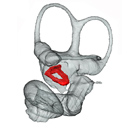
Fallen in a dead ear: intralabyrinthine preservation of stapes in fossil artiodactylsMaeva J. Orliac
Published online: 09/03/2016 |
S.I. Data |

|
Contributions à l'étude du gisement Miocène supérieur de Montredon (Hérault). Les grands mammifères. 6 - Les périssodactyles RhinocerotidaeClaude GuérinPublished online: 15/11/1988Keywords: Aceratherium; anatomy; Biostratigraphy; Dicerorhinus; Miocene; Montredon; Paleoecology; Upper Vallesian https://doi.org/10.18563/pv.18.ext.3-7-134 Abstract The Montredon site has yielded about hundred rhinoceros remains: PV article infos Published in Vol. 18, Ext (1988) |
|

|
The Pleistocene vertebrate fauna of Robinson Cave, Overton County, TennesseeJ. E. Guilday, H. W. Hamilton and A. D. Mc CradyPublished online: 20/01/1969Keywords: Fauna; Mammalia; Pleistocene; Tennessee https://doi.org/10.18563/pv.2.2.25-75 Abstract A late Pleistocene deposit of 60 species of vertebrates and 12 of invertebrates is described from Robinson Cave, Overton County, Tennessee, U.S.A. Forty-eight species of mammals are represented by at least 2,483 individuals; 10 % are extinct, 10 % occur in the state only as boreal relicts in the Great Smoky Mountains; 23 % no longer occur as far south as Tennessee; 57 % occur at or near the site today. Nínety-one percent of the Recent mammal species can be found living today in the Minnesota-Wisconsin area, approximately 10 degrees farther north. Fluorine analysis suggests a long period of accumulation. The following 10 mammalian species are recorded from Tennessee for the first time. Sorex arcticus, Microsorex hoyi, Citellus tridecemlineatus, Clethrionomys gapperi, Microtus pennsylvanicus, Synaptomys cooperi, Synaptomys borealis, Zapus nudsonius, Napaeozapus insignis, Martes americana. Six additional species are present as boreal relicts in the Great Smoky Mountains of eastern Tennessee but not at the site today : Sorex cinereus, Sorex dispar, Sorex palustris, Parascalops breweri, Glaucomys sabrinus, Mustela nivalis. Six forms are extinct: Canis dirus, Ursus americanus amplidens, Sangamona furtiva, Dasypus bellus, Mammut americanus,Megalonyx jeffersoni. Twenty-six additional species of mammals, all of the snails, birds, reptiles, and amphibians recovered from the fauna still inhabit the area today: The fauna is indicative of a cold-temperate climatic episode associated with the Wisconsin glaciation, but may be chronologically mixed. PV article infos Published in Vol. 02, Fasc. 2 (1969) |
|
