|
Difficulties with the origin of dinosaurs: a comment on the current debate
Published online: 01/07/2020
Keywords:
dinosaur anatomy; dinosaur evolution; Ornithoscelida; palaeobiogeography; Triassic Period
https://doi.org/10.18563/pv.43.1.e3
Abstract
The origin and early evolutionary history of the dinosaurs is a topic that has recently gone through a period of renewed interest and academic debate. For 130 years, one way of classifying the various dinosaur subgroups persisted as the accepted model, with increasing levels of research in the past quarter-century also providing evidence for the hypothesis that dinosaur origination occurred in the Southern Hemisphere, particularly in South America. It is, after all, from within the Late Triassic strata of countries like Argentina and Brazil that we get some of the very best early dinosaur specimens; many of these specimens are the earliest known representatives of some of the major dinosaur subgroups, such as the theropods and sauropodomorphs. However, some recent analyses have brought about a shift in terms of what is currently accepted and what is now disputed regarding the origin of dinosaurs – the Southern Hemisphere origination hypothesis was questioned (although this was based upon observations and not with quantitative analysis techniques), as has the shape of the dinosaur tree. Responses to the new hypothesis were numerous; many further supported a Southern Hemisphere point of origin. Whilst the interrelationships between the major dinosaur clades remains to be resolved, the current data does seem to comprehensively answer the question of where the dinosaurs first originated. However, it is arguable whether the current data that is being used in such palaeobiogeographical analyses is sufficient to provide an answer to the question of where specifically the dinosaur clade first appeared. This short communication urges a degree of caution about the current consensus and what steps may need to be taken to ensure that more meaningful results are produced in the future.
PV article infos
Published in Vol 43-1 (2020)
|
PDF
|

|
Une faune du niveau d'Egerkinger (MP 14; Bartonien inférieur) dans les phosphorites du Quercy (Sud de la France)
Published online: 18/12/1990
Keywords:
Biochronology; Early Bartonian; Eocene; evolution; Mammals; New taxa; Quercy
https://doi.org/10.18563/pv.20.1.1-32
Abstract
The Laprade fauna is chronologically situated between those from Egerkingen and Lissieu and consequently, is close to the MP 14 reference-level of the European mammalian biochronological scale (Symposium of Mainz, 1987).
This new fauna is presently the oldest known in the Quercy phosphorites, formerly the Le Bretou fauna (MP 16) was considered as the oldest one. The Laprade fauna includes 21 species which belong in 7 mammalian orders (Marsupialia: Amphiperatherium bastbergense, Amphiperatherium goethei; Apatotheria: Heterohyus (Gervaisyus) pygmaeus nov. subgen., nov. sp.; Lipotyphla: Saturninia cf. mamertensis, Saturninia cf. intermedia; Chiroptera: Vespertiliavus lapradei nov. sp.; Rodentia: Protadelomys cf. lugdunensis, Elfomys nov. sp.; Primates: Nannopithex cf. filholi, cf. Pseudoloris or Pivetonia; Perissodactyla: ?Palaeotherium ?castrense, small-sized Palaeotherium sp., Plagiolophus sp., Anchilophus sp.; Artiodactyla: Dichobune cf. robertiana, Mouillacitherium cartieri, Tapirulus cf. depereti, Mixtotherium priscum, Pseudamphimeryx schlosseri, and Artiodactyla indet). Sixteen of these species are mentioned for the first time from the Quercy faunas.
The recognition of a new apatemyid, Heterohyus (Gervaisyus) pygmaeus nov. subgen., nov. sp., attests to an early origin of a lineage known in the Late Eocene. The emballonurid bat Vespertiliavus lapradei nov. sp. is presently the earliest record of this genus and family. This Auversian fauna leads to discuss the age of taxa showing archaic features. These taxa were defined on specimens collected in the Quercy during the last century and have never been found in the Quercy localities recently investigated. This fauna bears also evidence of a karstic filling episode older than those previously dated by fossils in the Quercy Jurassic.
PV article infos
Published in Vol. 20, Fasc. 1 (1990)
|
PDF
|

|
Ein neuer condylarthre und ein tillodontier (Mammalia) aus dem Mitteleozän des Geiseltales.
Published online: 15/04/1986
Keywords:
Condylarthra; Eocene; Europe; Mammalia; taxonomy; Tillodontia
https://doi.org/10.18563/pv.16.1.35-53
Abstract
In the course of a revision of the Equoidea numerous dentitions as well as a partial skeleton of a Phenaeodont were discovered from the Middle Eocene lignite beds of the Geiseltal locality. These fossils are recognized as a new genus and species of Phenacodontidae : HaIlensia matthesi n.g. n.sp.. The species is present in the « untere und obere Unterkohle ›› (uUK, oUK = the lower and upper part of the Lower Coal Seam) as well as in the « obere Mittelkohle ›› (oMK = the upper part of the Middle Coal Seam). Two fragmentary upper jaws described and figured by Matthes (1977) as Propachynolophus gaudryi are also belonging to Hallensia matthesi. Thus the decisive argument for classifying the " Unterkohle " of the Geiseltal section as Lower Eocene has to be dropped. Another relict form of the Geiseltal is Esthonyx tardus n. sp. documented by a fragmentary mandible coming from the « untere Unterkohle ››. This is the latest Tillodont from Europe. Contrasting to E. munieri from the european Lower Eocene the dentition of E. tardus is morphologically more progressive.
PV article infos
Published in Vol. 16, Fasc. 1 (1986)
|
PDF
|

|
Contributions à l'étude du gisement Miocène supérieur de Montredon (Hérault). Les grands mammifères. 8 - Analyse paléoécologique de la faune mammalienne
Published online: 15/11/1988
Keywords:
France; Mammalia; Montredon; Paleoecology; Upper Miocene
https://doi.org/10.18563/pv.18.ext.177-186
Abstract
The species diversity of the mammalian fauna from Montredon (Hérault, France, late Miocene) is examined in terms of richness and abundance. A cenogramic analysis of the fossil mammalian community suggests the prevalence of open habitats, with the presence of marshes and of a poorly developed galery forest, and a climate rather warm and dry.
PV article infos
Published in Vol. 18, Ext (1988)
|
PDF
|

|
Contributions à l'étude du gisement Miocène supérieur de Montredon (Hérault). Les grands mammifères. 1 - Les Lagomorphes
Published online: 15/11/1988
Keywords:
Lagomorpha; Montredon; Prolagus; Upper Miocene
https://doi.org/10.18563/pv.18.ext.3-14
Abstract
A sample of 231 isolated teeth of lagomorphs from the upper Miocene of Montredon (southern France), identified as the ochotonid Prolagus crusafonii DOPEZ, 1975, is studied, comparing it with other populations of the same species as well as with its closest species P. oeningensis (KÖNIG, 1825).
The maintenance dining 5 m.y. of a high morphological variability in a group of non-selected features is interpreted as an evolutionary response. This may be related with the heterogeneity and probably too with the regression of the environment.
PV article infos
Published in Vol. 18, Ext (1988)
|
PDF
|

|
New murids and gerbillids (Rodentia, Mammalia) from Pliocene Siwalik sediments of India.
Published online: 15/12/1997
Keywords:
Dental morphology; evolution; new species of murids and gerbillids; phylogenetic relationships; Systematics
https://doi.org/10.18563/pv.26.1-4.129-165
Abstract
Murids and gerbillids (Rodentia, Mammalia) recovered from four Upper Siwalik localities; Moginand (around 3.5-4.5 m.y.), Kanthro (around 2.5 m.y.), Ghaggar (around 2 m.y.) and Nadah (around 1.8-2 m.y.) are described herein. A comparison of Mus linnaeusi sp. nov. reveals its close relationship towards the house mouse Mus musculus. In contradiction to earlier proposals that Golunda migrated to the Indian subcontinent from Africa sometime during Late Pliocene, it is suggested here that Golunda (in the form of Golunda tatroticus sp. nov.) evolved from Parapelomys robertsí of Late Miocene deposits of Siwaliks. Golunda tatroticus sp. nov. exhibits a progressive relationship to the extant Indian Bush Rat Golunda ellioti through Golunda kelleri and Golunda sp. Tatera pinjoricus sp. nov. is considered here to be a link between the extinct Abudhabia kabulense and the extant Tatera indica.
PV article infos
Published in Vol. 26, Fasc. 1-4 (1997)
|
PDF
|

|
Preliminary evolution of paleosols and implications for interpreting vertebrate fossil assemblages, Kuldana formation, Northern Pakistan
Published online: 16/12/1996
Keywords:
Eocene; Kuldana Formation; Pakistan; Paleosols; Pedogenic Carbonate; taphonomy; Time Averaging; Vertebrate Fossils
https://doi.org/10.18563/pv.25.2-4.261-277
Abstract
Paleosols and the taphonomy of vertebrate fossils in the Eocene Kuldana Formation of northern Pakistan provide important information on the preservation and time-averaging of fossil assemblages. Morphologic, mineralogic, and chemical data as well as comparisons with Quaternary soils suggest that Kuldana paleosols formed under generally dry and oxidizing conditions over time intervals of less than 100 000 years and perhaps as short as 1000 years. The distribution of carbonate in Kuldana paleosols further indicates that the upper half of the profiles were acidic whereas the lower halves were alkaline. Vertebrate fossils are rare in Kuldana paleosols and occur primarily in well-cemented sandstones and conglomerates with abundant micritic and iron-stained nodules that were reworked from floodplain soils. The scarcity of vertebrate remains in Kuldana paleosols probably reflects a combination of acidic, dry, and oxidizing conditions in the upper half of the profiles and rapid floodplain sedimentation. Comparisons between the taphonomic characteristics of Kuldana channel fossil assemblages and bone accumulations in modem rivers provide a basis for estimating the length of time represented by Kuldana fossils from several important localities. Vertebrate fossil assemblages from Barbora Banda are characterized by a low-diversity paleofauna, partially articulated skeletons, and bones that are sorted by size and shape. Comparison with bone accumulations in modern rivers suggests that the fossils from Barbora Banda accumulated in 1 to 10 years. Vertebrate fossils from the Lower Kuldana in the Kala Chitta Hills region, typified by locality H-GSP 62, are characterized by a high-diversity paleofauna and generally random and unsorted fossil bone distributions, which suggest that the fossils from these localities represent longer time intervals than the Barbora Banda fossils. Based on the time estimates for Kuldana paleosol development, fossil assemblages in Kuldana channel deposits in the Kala Chitta Hills region probably represent time intervals of about 1000 years.
PV article infos
Published in Vol. 25, Fasc. 2-4 (1996)
|
PDF
|

|
Diversity among north african dinosaur eggshells.
Published online: 15/12/2003
Keywords:
Cretaceous; Dinosaurs diversity; Eggshells; Maastrichtian; Morocco; North Africa; taxonomy
https://doi.org/10.18563/pv.32.2-4.171-188
Abstract
Until the discovery of dinosaur eggshells locality in the Oukdiksou syncline, (Middle Atlas, Morocco) in 1999 (Garcia et al. this volume) the maastrichtian reptiles faunas were unknown in North Africa. Additional material from Achlouj-2 allows us to describe five oospecies, belonging to four oofamilies. The Megaloolithidae is recorded by Megaloolithus maghrebiellsis Garcia el al. and Pseudomegaloolithus atlasi oogen. novo oospec. nov. Tipoolithus achloujensis Garcia et al. is questionably considered as a Subtiliolithidae. A relatively small Elongatoloolithidae is represented by Rodolphoolithus arioul oogen. nov. oospec. nov. A thin Prismatoolithidae is described as a new oospecies of ? Pseudogeckoolithus Vianey-Liaud & Lopez-Martinez, 1997: P. tirboulensis. The diversity of these oospecies indicates that the dinosaur fauna comprises at least five dinosaur oospecies, with perhaps one sauropod and three theropods.
PV article infos
Published in Vol. 32, Fasc. 2-4 (2003)
|
PDF
|

|
Long-term fidelity of megaoolithid dinosaurs to a large breeding-ground in the Upper Cretaceous of Aix-en-Provence (southern France).
Published online: 15/12/2003
Keywords:
Large nesting ground; megaloolithid eggs; Southern France; Upper Cretaceous
https://doi.org/10.18563/pv.32.2-4.109-120
Abstract
We present here the preliminary results from a new nesting site "Sextius-Mirabeau", discovered close to the historical centre of Aix-en-Provence in Upper Cretaceous deposits. This extensive megaloolithid nesting ground, the first large scale excavation (3225 m²) in France, yielded more than 530 eggs, some organized in clusters. Their study reveals the reproductive strategy of the megaloolithid egglayer group which indicates nesting fidelity and gregarious behaviour.
PV article infos
Published in Vol. 32, Fasc. 2-4 (2003)
|
PDF
|

|
Les Ischyrictis de la transition Vindobonien-Vallésien
Published online: 15/09/1972
Keywords:
Ischyrictis; Mustelidae
https://doi.org/10.18563/pv.5.5.253-260
Abstract
Le groupe des Mustélides « Ischyrictoïdes » développe des tendances évolutives qu’engendrent des formes de Carnassiers prédateurs robustes et de grande taille. C’est une évolution comparable à celle que l’on trouve chez Plesiogulo, qui, lui, a une origine énigmatique (Petter, 1963). Chez les Mustélides on peut signaler deux lignées assez nettes : celle du sous-genre nominal des Laphyctis, plus conservatrice, plus mustéliforme, renfermant les espèces Ischyrictis (Laphyctis) mustelinus VIRET et L. zibethoides BLAINVILLE ; celle de type félinoïde caractérisée par L. Ginsburg (1961) avec la forme type Ischyrictis (Hoplicitis) florancei du Vindobonien inférieur de Pontlevoy-Thenay et I. helbingi VIRET, 1951 du Vindobonien supérieur de la Grive Saint-Alban. De plus rappelons que I. vorax DEHM et I. comitans DEHM du Burdigalien de Wintershof-West sont sans rapport avec les espèces du Miocène supérieur (Ginsburg, o.c.).
Récemment G. Petter (o.c.) a montré la difficulté qu’il y avait à envisager que l’Ischyrictis de Can Llobateres qu’elle décrivait puisse être le descendant de Ischyrictis helbingi de La Grive : la forme plus récente est évidemment de plus grande taille, mais le développement très marqué et la position avancée du protocône paraissent constituer un obstacle à une telle filiation.
Donc on signalait jusqu’ici deux lignées de Mustélides « ischyrictoïdes » toutes deux de grande taille : d’une part I. zibethoides de Sansan, d’autre part I. helbingi de la Grive. Or à notre point de vue nous considérons actuellement qu’il existe très probablement trois phyla d’Ischyrictis. Le premier serait représenté par les formes burdigaliennes déjà nommées I. vorax et I. comitans ; il se caractériserait par la perte précoce de la P₁ inférieure et la forme spéciale de la canine inférieure. Ce premier ensemble pourrait être rassemblé dans le sous-genre Laphyctis. Le reste des ischyrictoïdes de type conservateur, pour ce qui est de la région des prémolaires et de la forme de la canine, pourrait être subdivisé en deux sous-genres : le sous-genre Ischyrictis désignant les formes les plus mustéliformes avec I. mustelinus et I. zibethoides d’une part, et le sous-genre Hoplicitis pour les formes félinoïdes avec I. florancei et I. helbingi.
PV article infos
Published in Vol. 05, Fasc. 5 (1972)
|
PDF
|

|
Etude du crâne de Pachynolophus lavocati n. sp. (Perissodactyla, Palaeotheriidae) des Phosphorites du Quercy
Published online: 15/02/1972
Keywords:
Perissodactyla; Quercy Phosphorites
https://doi.org/10.18563/pv.5.2.45-78
Abstract
The genus Pachynolophus, one of the poorest known of the Palaeotheriidae, includes the brachyodont forms with reduced and non-molariform premolars and with upper molars lacking a mesostyle. Quantitative characters (divers surface indications and elongation of the teeth), while demonstrating a close relationship to Hyracotherium, permit a better differentiation of the genus, confirm its specific splitting, and permit the distinction of three lineages. The skull from Memerlein is taken as the type of a new species, P. Iavocati, of which the dentition is extremely characterized by its lophiodonty, the strong reduction of the premolars and the reduction of the cingula. This characterization testifies to a late age which extends the existence of the genus quite near to the Eocene-Oligocene limit. Compared with the only two skulls known of related species (Hyracotheríum vulpiceps and Pachynolophus Iivinierensis), that from Memerlein is distinguished by progressive characters affecting diferent regions but most particularly the braincase; it is not possible, however, to isolate within this evolution the part which leads to a systematic differentiation. Modernization is translated by a considerable increase in size of the braincase, principally in the frontal region, a development of the facial region with anterior displacement of the dental series and a greater specialization of the masticatory apparatus. This evolution parallels the history of the Equidae of the North American early Tertiary, but certain particularities, the form of the alisphenoid, the presence of an anterior frontal foramen, and the structure of the paroccipital apophysis, testifies to the independance of the European forms.
PV article infos
Published in Vol. 05, Fasc. 2 (1972)
|
PDF
|

|
Analyse d'ouvrage : "Mammoths, mastodonts & elephants. biology, behavior and the fossil record. Gary HAYNES, 1992. Cambridge University Press, New York, xii + 413 p., ISBN 0-521-38435-4"
Published online: 11/02/1993
Keywords:
Elephants; Mammoths; Mastodonts
https://doi.org/10.18563/pv.22.2-3.137-139
Abstract
L'ouvrage est divisé en trois grandes parties traitant successivement: I. l'anatomie ("Proboscidean flesh and bones"), en abordant la taxonomie, l'allure générale et l'éco-éthologie des proboscidiens actuels et fossiles; II. les causes de mortalité collective naturelle et provoquée chez les actuels; III. les documents fossiles et l'extinction des formes anciennes d'Amérique du Nord.
PV article infos
Published in Vol. 22, Fasc. 2-3 (1993)
|
PDF
|

|
Un nouveau genre de ?Palaeotheriidae (Perissodactyla, Mammalia) décelé dans les phosphorites du Quercy (Eocène supérieur ou Oligocène) d'après un arrière crâne sans dents.
Published online: 15/06/1999
Keywords:
endocranial cast; Epitympanic sinus; Palaeotheriidae; Paléogène; Quercy Phosphorites; skull anatomy
https://doi.org/10.18563/pv.28.1.75-87
Abstract
A rear skull from the Quercy Phosphorites is described. It documents a new perissodactyl genus, likely assignable to the family Palaeotheriidae and probably paleogene of age. Owing to the lack of any tooth, this family assignment remains however somewhat hypothetical. The specimen is firstly characterised by the presence of a wide epitympanic sinus swelling and hollowing the squamosal shell and the post-glenoid process. This cavity might make up a peculiar pattern of improvement for the hearing apparatus by carrying out a kind of drum near the middle ear, whereas the bony tympanic remains barely bulged and forms but a few developed auditory bulla. This pattern appears an outcome of a trend observed with many palaeotheriids, such as Plagiolophus. Furthermore, the endocranial cast shows a rather high degree of gyrencephaly for a paleogene mammal. The prominent lambdoidal crest points out a powerful nape musculature and a lowered head bearing. Consequently, it is assumed that such an animal was probably living in somewhat open places, at the expense of rather tough vegetables. It might have been accordingly provided with a semi-hypsodont, cement covered, "plagiolophoid" dentition.
PV article infos
Published in Vol. 28, Fasc. 1 (1999)
|
PDF
|

|
The evolution of the molar pattern of the Erethizontidae (Rodentia,Hystricognathi) and the validity of Parasteiromys Ameghino, 1904.
Published online: 15/06/1999
Keywords:
Argentina; Erethizontidae; Hystricognathi; Miocene; Molar evolution; Porcupines; Rodentia; Systematics
https://doi.org/10.18563/pv.28.1.53-73
Abstract
The genus Parasteiromys AMEGHINO, 1904 is revalidated, and P. friantae sp. nov. (Hystricognathi, Erethizontidae) from Colhuehuapian (early Miocene) sediments of the southern cliff of Colhue-Huapi Lake (Province of Chubut, Argentina), is described. The molar morphology of these taxa and of living porcupines adds new elements to understand the dental evolution of the Erethizontidae, and to propose the hypothetical ancestral molar pattern for this family. This pattern does not correspond to any of the morphologies traditionally proposed as ancestral for South American hystricognathous rodents. The proposed pattern is characterized by a metaloph disconnected from the posteroloph and oriented towards the hypocone, and the third loph incompletely developed with the lingual portion homologous to the mesolophule of Baluchimyinae (Chapattimyidae) from the Miocene of Pakistan. The inferred steps of the molar evolution of erethizontids towards the pentalophodont condition, considered derived for the family, are illustrated. This study strengthens the hypothesis placing erethizontids in a basal position among rodents of the suborder Hystricognathi.
PV article infos
Published in Vol. 28, Fasc. 1 (1999)
|
PDF
|

|
The skull of Arsinoitherium (Mammalia, Embrithopoda) and the higher order interrelationships of ungulates
Published online: 17/12/1992
Keywords:
Arsinoitherium; PHYLOGENY; Skull; Ungulate
https://doi.org/10.18563/pv.22.1.1-43
Abstract
Detailed anatomical description of arsinoithere cranial remains from the Lower Oligocene, Fayum Depression, Egypt, provides the basic data for a systematic investigation. All cranial and some postcranial features are assessed from a phylogenetic standpoint. Several soft tissue characters are then added to a cladistic analysis based on 54 derived ungulate morphological characters. The resulting phylogenetic hypothesis implies that perissodactyls, sirenians, proboscideans and arsinoitheres constitute a monophyletic unit (5 synapomorphies). However, increasing the tree length by 3 steps reveals a closer association between hyraxes and perissodactyls. Nevertheless, 13 synapomorphies link proboscideans, sirenians and arsinoitheres to the exclusion of all other ungulates. Form of the sphenopalatine and ethmoid foramina, recurved posttympanic process, absence of a fenestra rotundum in the petrosal, vestigial paroccipital process of the exoccipital and the highly unusual absence of a hypoglossal foramen in the skull, imply a robust sister-group relationship between arsinoitheres and proboscideans. In this analysis artiodactyls share only one derived character with all other ungulates studied. Monophyly of Ungulata, including Artiodactyla, is therefore only weakly supported. It is argued that pedal anatomy of hyraxes is non-homologous with that of Tethytheria. Arsinoitherium should now be classified within Tethytheria, sharing a sister-group relationship with Proboscidea. Hyraxes are excluded, thus refuting the concept of Paenungulata. However, monophyly of the wider concept, Pantomesaxonia, containing hyraxes, perissodactyls, sirenians, proboscideans and now, arsinoitheres, is supported by this study.
PV article infos
Published in Vol. 22, Fasc. 1 (1992)
|
PDF
|

|
First evidence of an early Miocene marine teleostean fish fauna (otoliths) from la Paillade.(Montpellier,France)
Published online: 15/06/1999
Keywords:
Aquitanian; Biostratigraphy; La Paillade; marine deposits; Miocene; otoliths; Palaeoecology; Palaeogeography; Southern France; Teleostei
https://doi.org/10.18563/pv.28.1.1-46
Abstract
A fossil fish fauna, based on 5533 otoliths, from the La Paillade locality at Montpellier is described and figured. The otolith-bearing marls correlate to mammal zone MN l (Aguilar, 1982), and thus represent the earliest Miocene. The fish fauna consists of 30 taxa belonging to 20 families. Two species are new: Dussumieria sittigi and Liza gaudanti. The predominant faunal element is the Lesueurigobius vicínalis-species complex, composing 73% of all investigated otoliths. The palaeoecological analysis reveals a marine to euryhaline fish fauna living under tropical to subtropical conditions in the transition zone littoral - sublittoral. Water depth probably was more than 10 m. The scarcity of pelagic físhes suggests that the habitat was either a sheltered bay and/or far away from the open sea. Furthermore, some genera represented in the La Paillade fish fauna presently live exclusively in the Indopacific realm. Their presence strongly supports a broad connection between the Indian Ocean, the Mediterranean, and the Paratethys Seas during the Early Miocene (Aquitanian). From a palaeobiogeographical point of view, faunal relationships were found between the La Paillade fish fauna and both the Paratethys fish fauna and the fish fauna from the deposits in the Upper Rhinegraben and the Mayence and Hanau Basins (Germany).
PV article infos
Published in Vol. 28, Fasc. 1 (1999)
|
PDF
|

|
Rongeurs muroidés du Néogène supérieur d'Afghanistan, évolution, biogéographie, corrélations
Published online: 30/09/1981
Keywords:
Afghanistan; Muroidea; Neogene
https://doi.org/10.18563/pv.11.4.133-179
Abstract
The rodent faunas of five afghan localities found in 1976 and 1977 (Sherullah, Ghazgay, Pul-e Charkhi, Dawrankhel 14 and 15) are studied.
The rodents (Muridae, Cricetidae and Rhizomyidae) represent 8 genera and 10 species. The detailed description of the 2 new genera and 7 species diagnosed in 1979 is given. An other species is created : Pseudomeriones crapouilloti n. sp. These faunas precise the origin and diversification of Muridae and Cricetidae. A phyletic lineage known in Afghanistan is represented in East Africa by a ramus or a collateral lineage. The five localities are dated from Lower Turolian to Ruscinian. They constitute the frame of a chronologie scale for the Upper Continental Neogene of Afghanistan.
The study of afghan material brings new data to the biogeography of Old Word's rodents during the Upper Neogene; from Pakistan to Europe and Africa, a rather warm and damp province would have existed till Upper Miocene; after which (in the mio-pliocene epoch) it would have divided into 3 parts, by aridification of the central area.
PV article infos
Published in Vol. 11, Fasc. 4 (1981)
|
PDF
|

|
Evolution des Aplodontidae Oligocènes Européens
Published online: 01/10/1979
Keywords:
Aplodontidae; Europe; Oligocene
https://doi.org/10.18563/pv.9.2.33-82
Abstract
Until now Aplodontidae of the European Oligocene have been documented by four species only. The phylogenetic relations remained obscure. as the distribution of only one species has been known in some detail. New material made it possible to define the stratigraphic range of two of the already existing species (Plesispermophilus angustidens, Sciurodon cadurcense) and to follow their development during the Oligocene beginning with the event of the « Grande Coupure ››. Sciurodon remained nearly without change until the end of the Middle Oligocene. Plesispermophilus angustidens split into two distinct phyletic lines, one of which (P. macrodon n. sp.) reaching considerable size, is represented till the beginning of the Upper Oligocene (Pech de Fraysse, Gaimersheim). The other line leads to Plesispermophilus ernii (basal Upper Oligocene of Burgmagerbein 1. terminal Upper Oligocene of Coderet). Besides the already known forms a new small-sized species (P. atavus n. sp.) is described, which by its primitive features closely resembles the genus Plesispermophilus. Two other small-sized species already known from the Upper Oligocene (? P. argoviensis) and Lower Miocene (? P. descedens) seem to be closely related to the new species. It cannot be decided whether they are descendents of this line or have developed independently, because of their poor fossil record.
Comparison of the evolutionary modalities in the different phylogenetic lines reveals general trends. the most striking of which is the complication of the tooth pattern by the development of additional crests. In the lower molars the cusps diminuate in size and are more and more transformed into ridges. ln addition new connection between the crests appear. in the upper molars, the « selenodont » shape of the teeth becomes more and more dominant, and in the two main evolutionary lines of Plesispermophilus the metaconulus becomes duplicated. A further evolutionary trend is the size increase of the premolars compared to the molars, which is even more pronounced in the Miocene Aplodontidae.
Phylogenetic relations between the primitive Plesispermophilus and certain « prociurines ›› of Northern America as well as between Plesispermophilus (P. angustidens) and more progressive forms of the Upper Oligocene (P. ernii, P. macrodon n. sp.) can be documented. In this light, the taxonomic distinction between Prosciurinae (bunodont) and Allomyinae (selenodont) sensu Rensberger 1976 can be shown to be artificial, because it separates forms from each other, which are evidently closely related. Consequently the separation into two subfamilies has been abolished.
PV article infos
Published in Vol. 09, Fasc. 2 (1979)
|
PDF
|
|
First Neogene Otonycteris (Chiroptera: Vespertilionidae) from Ukraine: its biostratigraphic and paleogeographic significance.
Published online: 19/03/2015
Keywords:
bats; East Europe; Gritsev; Late Miocene; Mammalia
https://doi.org/10.18563/pv.39.1.e2
Abstract
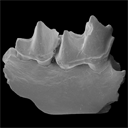
A new species, Otonycteris rummeli nov. sp., is described from the Late Miocene site Gritsev (MN 9) in the Ukraine. Otonycteris rummeli nov. sp. differs from those of most vespertilionids, except recent Otonycteris, Antrozous and Early Miocene Karstala silva, in having a well-developed entocingulid at the foot of the trigonid valley in the lower molars. The morphological resemblance of Otonycteris, Antrozous and Karstala is apparently a case of convergence in the evolution of the Old and New Worlds bat faunas. From at least the Middle Miocene the range of Otonycteris distribution spread to the whole of Central Europe and such a situation continued during the whole Late Miocene. This indicates a more arid climate in Europe during the Upper Miocene compared to the Quaternary. The reduction of the distribution range of Otonycteris and its extinction in most of the territory of Europe could have been caused by the global climatic cooling and increasing glacial cycle amplitude during the onset of the Quaternary.
PV article infos
Published in Vol.39-1 (2015)
|
PDF
|

|
Pantolestidae nouveaux (Mammalia, Insectivora) de l'Eocène moyen de Bouxwiller (Alsace).
Published online: 31/03/1970
Keywords:
Bouxwiller; Insectivora; Mammalia; Middle Eocene; Pantolestidae
https://doi.org/10.18563/pv.3.3.63-82
Abstract
The Pantolestidae from the middle eocene of Bouxwiller are the subject of a detailed study. Buxolestes hammeli (n. g., n. sp.) is not closely related to any other European or North American form described until now; it presents, however, some characters in common with Pantolestes, a form of the same age from North America. A parallel evolution from a common ancestral form could explain this ressemblance.
Another form (gen. and sp. indet.) accompanies Buxolertes hammeli in the Bouxwiller fauna.
PV article infos
Published in Vol. 03, Fasc. 3 (1970)
|
PDF
|