
Abstract book of the 18th Conference of the EAVP
Pterosaurs from Coahuila
New elephant cranium from early Pliocene Ileret, Kenya
Les sélaciens du Miocène de la région de Montpellier
Muridae du Pliocène supérieur d'Espagne et du midi de la France.
Contribution à l'étude des genres Gliravus et Microparamys.
Eocene (57) , Quercy Phosphorites (38) , Systematics (32) , Rodents (29) , Mammalia (27) , Rodentia (25) , Miocene (25)
Page 18 of 19, showing 20 record(s) out of 366 total

|
Rana (Amphibia : Ranidae) from the upper eocene (MP17a) Hordle Cliff locality, Hampshire, England.Alan J. Holman and David L. HarrisonPublished online: 15/06/1999Keywords: Amphibia; England; Rana; Ranidae; Upper Eocene https://doi.org/10.18563/pv.28.1.47-51 Abstract An ilium from the Upper Eocene (MP l7a) of Hordle, England, represents the first report of Rana from the Eocene of Britain. The ilium is similar to those of the water frog (Rana [ridibunda]) species group. PV article infos Published in Vol. 28, Fasc. 1 (1999) |
|

|
New records of the pantodont Archaeolambda from the Paléocène of southern ChinaSuyin Ting, Judith A. Schiebout and Jianjian ZhengPublished online: 16/12/1996Keywords: Archaeolambda; China; Paleocene; Pantodont https://doi.org/10.18563/pv.25.2-4.125-132 Abstract Two new finds of pantodont materials from southern China, assigned to Archaeolambda, are described in this paper. One, a new species from the Nanxiong Basin, Guangdong Province, is similar to Alcidedorbignya inopinata from the early Paleocene of Tiupampa, Bolivia in size. It provides reliable evidence of the occurrence of Archaeolambda in the early-middle Paleocene of southern China. The second find includes specimens of Archaeolambda sp. cf. A. planicanina from the ?late Paleocene of Hengyang Basin, Hunan Province, which are the first record of a fossil mammal from the area near Hengyang city. The only vertebrate fossils previously found here were two genera of crocodiles discovered in 1938. This find sheds new light on the local biostratigraphy. PV article infos Published in Vol. 25, Fasc. 2-4 (1996) |
|

|
Les Tayassuidés des phosphorites du QuercyLéonard GinsburgPublished online: 15/11/1974Keywords: Quercy Phosphorites; Tayassuidae https://doi.org/10.18563/pv.6.1-2.55-85 Abstract Revision of the Tayassuidae from the old collections of the Quercy leads to interesting facts about taxonomic and phylogenetic problems. It could not have been well done without constant comparison with contemporaneous Tayassuidae from stratified series, as well as with European Miocene Tayassuidae and Hyotheriinae. The result is that only three species are present in the Phosphorites of Quercy: Doliochoerus quercyi FiLHOL (represented by two sub-species: the older, D. quercyi quercyi and the more recent, D. quercyi aquensis), Palaeochoerus gergorianus CROIZET et BLAINVILLE and Palaeochoerus purillus nov. sp. The two former species disappeared with Stampian time, while the third is the direct ancestor of the Aquitanian Palaeochoerus typus POMEL, which became extinct before the beginning of Burdigalian. PV article infos Published in Vol. 06, Fasc. 1-2 (1974) |
|

|
Dilambodont Molars :a functional interpretation of their evolutionPercy M. ButlerPublished online: 16/12/1996Keywords: Convergent evolution; Dilambdodont; Molar function; Molar teeth https://doi.org/10.18563/pv.25.2-4.205.213 Abstract In dilambdodont molars the primitive crest between paracone and metacone (centrocrista) is represented by a pair of crests that join the mesostyle (postparacrista, premetacrista). The cutting action of these crests against the crests of the hypoconid is described. Dilambdodonty is a derived adaptation for greater cutting efficiency. It has evolved several times and in more than one way. PV article infos Published in Vol. 25, Fasc. 2-4 (1996) |
|

|
A primitive Emballonurid bat (Chiroptera, Mammalia) from the Earliest Eocene of EnglandJerry J. HookerPublished online: 16/12/1996Keywords: bats; Early Eocene; Emballonuridae; Origins; PHYLOGENY https://doi.org/10.18563/pv.25.2-4.287-300 Abstract A new genus, Eppsillycteris, is erected for Adapisorex? allglicus COOPER, 1932, from the earliest Eocene Blackheath Beds of Abbey Wood, London, England. Various derived character states indicate that it belongs to the order Chiroptera (bats) rather than to the extinct "insectivore" family Adapisoricidae. Other derived character states are shared with fossil and modern members of the family Emballonuridae. Placement of the new genus in this family extends the record of the Emballonuridae back in time by about 10 million years. It is the earliest record of a modern bat family and one of the earliest bats. This implies that the differentiation of at least some modern bat families took place in the Palaeocene, where no authenticated records of bats yet exist. The primitive characters of the earliest bats make the family Nyctitheriidae an unlikely stem group for the order Chiroptera. A tentative plausible alternative exists in some unnamed upper molars from the Palaeocene of Walbeck, Germany. Wyollycteris chalix, described as a bat from the Late Palaeocene of Wyoming, U,S.A., fits better in the family Nyctitheriidae. PV article infos Published in Vol. 25, Fasc. 2-4 (1996) |
|

|
Origins of avian reproduction: answers and questionsfrom dinosaurs.David J. Varricchio
Published online: 15/12/2003 |
|

|
Palaecarcharodon orientalis (Sinzow) (Neoselachii : Cretoxyrhinidae), from the Paleocene of maryland, USA.Gerard R. CasePublished online: 15/09/1989Keywords: Maryland; Palaeocarcharodon; Paleocene; Selachian; Systematics; U.S.A. https://doi.org/10.18563/pv.19.1.1-6 Abstract Recent collecting of fossil vertebrate remains from the lowermost member of the Aquia Formation (Paleocene), has enabled me to report here for the very fIrst time, the earliest occurrence for the teeth of Palaeocarcharodon in the fossil record of the New World. PV article infos Published in Vol. 19, Fasc. 1 (1989) |
|

|
Mode de vie et affinités de Paschatherium (Condylarthra, Hyopsopontidae) d'après ses os du tarseMarc Godinot
Published online: 16/12/1996 |
|

|
Analyse d'ouvrage : "Mammoths, mastodonts & elephants. biology, behavior and the fossil record. Gary HAYNES, 1992. Cambridge University Press, New York, xii + 413 p., ISBN 0-521-38435-4"Jean-Loup WelcommePublished online: 11/02/1993Keywords: Elephants; Mammoths; Mastodonts https://doi.org/10.18563/pv.22.2-3.137-139 Abstract L'ouvrage est divisé en trois grandes parties traitant successivement: I. l'anatomie ("Proboscidean flesh and bones"), en abordant la taxonomie, l'allure générale et l'éco-éthologie des proboscidiens actuels et fossiles; II. les causes de mortalité collective naturelle et provoquée chez les actuels; III. les documents fossiles et l'extinction des formes anciennes d'Amérique du Nord. PV article infos Published in Vol. 22, Fasc. 2-3 (1993) |
|
|
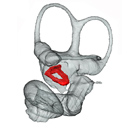
Fallen in a dead ear: intralabyrinthine preservation of stapes in fossil artiodactylsMaeva J. Orliac
Published online: 09/03/2016 |
S.I. Data |

|
La poche à phosphate de Ste-Neboule (Lot) et sa faune de vertébres du Ludien Supérieur. 1 La poche et son remplissageBernard GèzePublished online: 15/09/1978Keywords: Eocene; Quercy Phosphorites https://doi.org/10.18563/pv.8.2-4.171-173 Abstract La poche de Ste-Néboule, commune de Béduer (Lot), 15 km environ à l'WSW de Figeac, fait partie du groupe le plus septentrional des gouffres creusés par les ruissellements du Paléogène dans les calcaires jurassiques de la bordure sud-ouest du Massif Central et qui furent comblés à la même époque par des argiles sidérolithiques accompagnées de phosphate de chaux concrétionné ainsi que des restes de la célèbre faune dite «des phosphorites du Quercy» . PV article infos Published in Vol. 08, Fasc. 2-4 (1978) |
|

|
Description des restes d'Elasmobranches (Pisces) du Dévonien moyen de BoliviePhilippe Janvier
Published online: 01/02/1977 |
|

|
Fossil mammals and the age of the changxindian formation, Northeastern ChinaSpencer G. LucasPublished online: 16/12/1996Keywords: Changxindian Formation; China; Eocene; Fossil mammals https://doi.org/10.18563/pv.25.2-4.133-140 Abstract Re-evaluation of the small collection of mammal fossils from the Changxindian Formation near Beijing, China indicates the following taxa are present: Eutheria, Hypsimilus beifingensis, cf. Miacis sp., Anthracotheriidae and Forstercooperia grandis. The presence of Forstercooperia grandis indicates an Irdinmanhan age and does not support previous assignment of a Sharamurunian age to the Changxindian Formation. PV article infos Published in Vol. 25, Fasc. 2-4 (1996) |
|

|
Contributions à l'étude du gisement Miocène supérieur de Montredon (Hérault). Les grands mammifères. 9 - Une tentative de magnétostratigraphieSevket Sen
Published online: 15/11/1988 |
|

|
Découverte d'un gisement de micromammifères d'âge Pliocène dans le bassin de Constantine (Algérie), présence d'un muridé nouveau : Paraethomys Athmeniae n.sp.Brigitte Coiffait and Philippe-Emmanuel CoiffaitPublished online: 16/05/1981Keywords: Algeria; Constantine; Micromammals; Muridae; Pliocene https://doi.org/10.18563/pv.11.1.1-15 Abstract The study of that locality allowed the description of a new Muridae : Paraethomys athmeniae n. sp. It reveals the existence of new rodent for Algeria : first, a Sciuridae, Atlantoxerus cf. rhodius, and second, a Gliridae, Eliomys truci. So, that work shows the presence of the genus Eliomys in North Africa before the middle of Pleistocene. Lastly, Paraethomys cf. anomalus gives an exact datation of that bed. PV article infos Published in Vol. 11, Fasc. 1 (1981) |
|
|
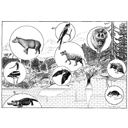
Essai de reconstitution d'un paysage du Quercy vers -35 Ma. (Esquisse de Christian Pondeville, 1977).Monique Vianey-Liaud
Published online: 15/09/1978 |
|

|
Avant propos au "Premier catalogue des specimens-types Paléontologiques déposés dans les collections de l'Université de Montpellier II"Jean-Jacques Jaeger
Published online: 20/12/1994 |
|

|
New records of terrestrial Mammals from the upper Eocene Qasr el Sagha Formation, Fayum Depression, EgyptPatricia A. Holroyd
Published online: 16/12/1996 |
|

|
Sur le statut taxonomique de Myotis KAUP 1829 (Mammalia, Chiroptera).Henri MenuPublished online: 15/12/1988Keywords: Myotis; taxonomy https://doi.org/10.18563/pv.18.4.263 Abstract Suite à la récente publication d'une révision systématique des Chiroptera Vespertilioninae, conduite sur la base des morphologies dentaires comparées (Menu 1987), une remarque bienveillante du Dr. V. Aellen (Muséum d'Histoire Naturelle de Genève) a attiré l'attention de l'auteur sur un point précis du Code International de Nomenclature Zoologique. PV article infos Published in Vol. 18, Fasc. 4 (1988) |
|

|
Book review : Dr. Robert R. REISZ, 1986. Encyclopedia of Paleoherpetology, Volume: 17A: Pelycosauria.Jean-Yves CrochetPublished online: 20/06/1987Keywords: Book review; Paleoherpetology https://doi.org/10.18563/pv.17.2.75-76 Abstract L’Encyclopedia of Paleoherpetology, Part 17A : Pelycosauria de Robert R. Reisz (1986) offre une synthèse complète des synapsides les plus primitifs et les plus anciens, essentiels pour comprendre l’évolution précoce de ce groupe majeur de vertébrés. L’ouvrage commence par un historique, suivi d’une analyse ostéologique détaillée du crâne, du squelette axial et appendiculaire. PV article infos Published in Vol. 17, Fasc. 2 (1987) |
|
